Ice Therapy: When Something Hurts, Cool It Down
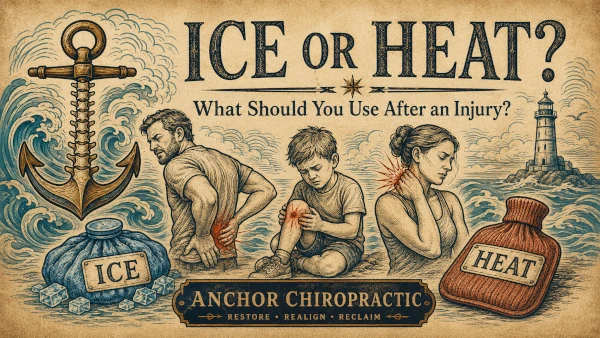
You hurt your back. You twist an ankle. You spend all Saturday shoveling dirt, gardening, lifting, driving, or doing one of those jobs that was supposed to take twenty minutes. Now the question comes up: should you use ice or heat?
If something is freshly hurt, use ice.
Why a Fresh Injury Starts to Throb
Imagine you hit your thumb with a hammer.
Everybody has done it.
The funny thing is, it doesn’t usually hurt its worst the instant you hit it.
You grab your thumb.
You shake your hand.
You say a few words I probably shouldn’t print on this website.
Then…
Boom…boom…boom…
Now it’s really hurting.
Why?
Because your body immediately starts trying to protect the injured area.
Blood vessels open.
Fluid leaks into the tissue.
Clotting begins.
Inflammation starts.
That’s exactly what your body is supposed to do.
The problem is that all of that fluid has to go somewhere.
As swelling builds, pressure builds.
The injured tissues become crowded.
The nerves in that area get compressed and irritated.
Now every heartbeat sends another little pulse of pressure into the injury.
That’s why a fresh injury often throbs.
Bump…bump…bump…
Ouch.
Why I Avoid Heat on a Fresh Injury
Now think about what heat does.
Heat increases circulation.
That can be wonderful for a stiff muscle that has been tight for months.
But if you’ve just sprained an ankle, strained your back, or smashed your thumb with a hammer, bringing even more blood into an area that is already swelling usually isn’t helping.
It’s like adding another garden hose to a bucket that’s already overflowing.
More fluid.
More pressure.
More throbbing.
More pain.
That’s why my first choice for a fresh injury is usually ice.
Ice helps slow that process down.
It helps limit swelling.
Less swelling usually means less pressure.
And less pressure often means less pain.
The Old Doctor’s Shoveling-Dirt Lesson
The old chiropractor who taught me had a simple way of explaining it.
He’d ask,
“If you had to shovel a pile of dirt all afternoon, would you rather do it on a hot day or on a cool day?”
Nobody ever picked the hot day.
You get tired faster.
Everything feels heavier.
You overheat.
Your body works better when it isn’t cooking itself.
The same idea applies to an injured body part.
When something has just been hurt, I don’t want to heat it up.
I want to cool it down.
What I Learned After Snowboarding
I’ve tested this on myself more than once.
After spending the day snowboarding, my legs and low back have been worked hard.
The Hot Tub feels fantastic.
While I’m sitting in it.
The problem shows up the next morning.
More than once I’ve climbed out of bed thinking,
“I probably shouldn’t have done that.”
I’ve found that I usually wake up stiffer and sorer after soaking in hot water than if I had simply cooled things down and let my body recover.
That’s one reason you’ll rarely hear me recommend heat immediately after a hard day or a fresh injury.
When I Usually Recommend Ice
- New back or neck pain
- A fresh sprain or strain
- Swelling
- Throbbing pain
- Pain after lifting
- Pain after gardening or yard work
- Pain after sports
- A recent flare-up
- Soreness after a long physical day
- A new injury from an auto accident
How to Apply Ice Properly
1. Protect the skin
Place a thin, damp cloth between the ice pack and your skin.
Also state:
- Do not apply ice directly to bare skin.
- Do not lie on top of the ice pack.
- Do not fall asleep with it in place.
2. Ice larger areas for 15–20 minutes
Examples:
- Low back
- Upper back
- Neck
- Shoulder
- Hip
- Thigh
3. Ice smaller areas for 10–15 minutes
Examples:
- Wrist
- Hand
- Elbow
- Knee
- Ankle
- Foot
4. Let the area warm back up
Use:
- 15–20 minutes on
- At least 20–40 minutes off
- Repeat later as needed
What Can You Use as an Ice Pack?
- Flexible gel pack
- Ice in a towel
- Traditional ice bag
- Bag of frozen peas
When Not to Use Ice Without Guidance
- Poor circulation
- Loss of skin sensation
- Neuropathy
- Open wounds
- Broken or infected skin
- Severe cold sensitivity
If you cannot properly feel the temperature of the skin, do not guess.
Ice Is First Aid, Not the Whole Answer
Ice may calm the pain down. That is useful. But it does not necessarily correct the reason the problem keeps returning.
Then use real-life examples:
- Your back goes out every time you lift.
- Neck pain returns after driving.
- You wake up stiff every morning.
- Gardening puts you down for two days.
- Pain keeps traveling into an arm or leg.
Sometimes the joint is not moving correctly. Sometimes the surrounding muscles are guarding. Sometimes the injury needs to be examined properly.
Still Not Sure Whether to Use Ice or Heat?
Call Anchor Chiropractic Center. Tell us what happened, when it happened, and what the area feels like. We will point you in the right direction.
Your Body … has an incredible ability to heal itself. Sometimes it just needs the right environment to do its job. Ice can help create that environment after a fresh injury. If you’re not improving, or if the problem keeps coming back, let’s figure out why.
Fresh Injury?
Avoid Heat. Use ICE carefully. Let the area warm back up between applications.
If the pain is severe, worsening, repeatedly returning, or interfering with sleep, work, driving, or normal movement, have it evaluated.